

Our Story
MicroSociety® was built on a simple belief:
Children grow when they’re trusted with work that is meaningful to them.
Kids want to make meaning of their lives. If we treat them like they are not capable, we won’t get very far. We have to leverage what they do have and believe that if we give them opportunity, that they will rise to the occasion.
Dr. George Richmond
Founder, MicroSociety Inc.


Built to Adapt—and Built to Last
Education trends come and go. What matters is staying power—the ability to keep improving while holding tight to what works.
For more than 40 years, MicroSociety has endured—not because it is “shiny and new,” but because schools have experienced something rare: a learning environment where students discover who they are, how the world works, and where they fit. Here, they develop agency, purpose, knowledge, and practical skills through the daily practice of building their own society within their school—one that evolves alongside, and sometimes beyond, the world outside it.

Our History: A Model for All Time
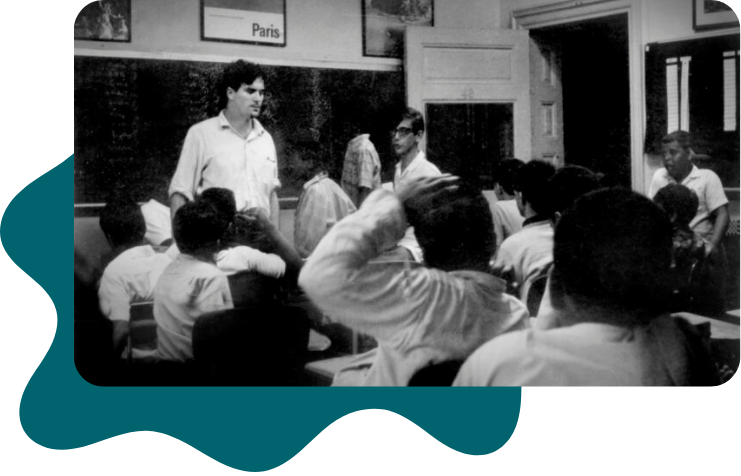
1967 — A New Idea Takes Shape
MicroSociety is conceived in the classroom of the late Dr. George H. Richmond—painter, poet, author, and educator—during his first teaching job in a Brooklyn elementary school serving children in poverty. His classroom is a rookie teacher’s nightmare—students skipped class, scorned homework, and tuned out lectures.
George realizes a hard truth: If students don’t want to learn, teachers can’t teach them—and poverty remains the outcome. From that frustration emerges a new vision for education—one rooted in motivation, dignity, and purpose. What if students are trusted with real responsibility and meaningful work inside a community they helped build?
That question leads to the core of the MicroSociety experience: learning through practice, participation, and purpose.

1973 — The Idea Becomes a Framework
After developing the MicroSociety concept in his Brooklyn classroom, George goes on to earn a doctorate in education and a master’s in public administration from Harvard University.
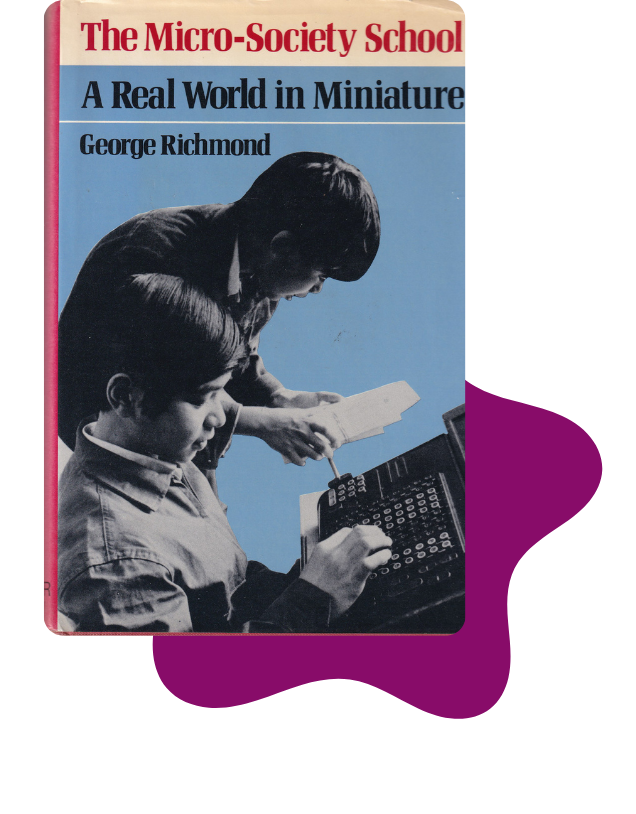
In 1973, his dissertation is published as the book The Micro-Society School: A Real World in Miniature, to the acclaim of teacher and management guru Peter Drucker, who calls it “the most moving, the most touching, the most profound, the most optimistic, the most imaginative, and the most practical book on children and schools in many, many dreary years.”
A chapter is included in Raising Children in Modern America: Problems and Prospective Solutions (1974), a book compiled by Harvard and MIT faculty luminaries, including future Supreme Court Justice Stephen Breyer, Professor Jerome Kagan, and Children’s Defense Fund Founder Marian Wright Edelman.
The book remains the bible of MicroSociety educators to this day.

1981 — The First Whole-School MicroSociety
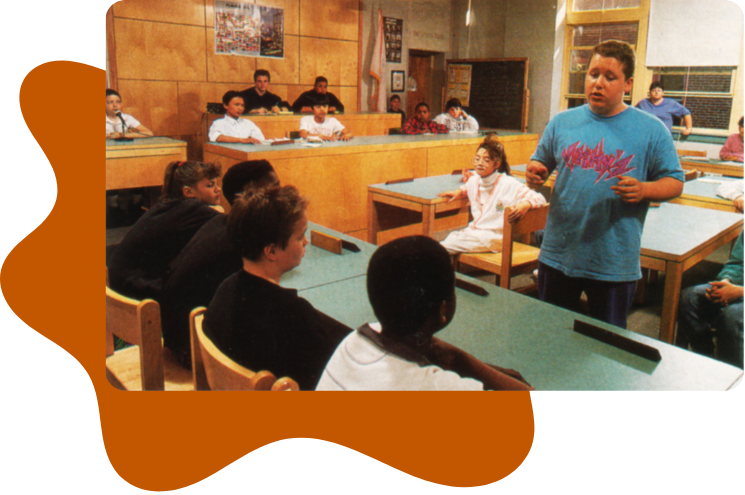
The first whole-school MicroSociety opens its doors in 1981 at City Magnet School in Lowell, Massachusetts, founded by educators who read George’s book and believe in its promise.
This marked a critical shift: MicroSociety is no longer just a classroom teacher’s dream—it is now a viable school-wide model, reshaping teaching and learning across an entire school community.

1989–1991 — National Attention and Early Recognition
The model draws national attention for its innovative approach to learning by doing. In 1989, Chrysler Chairman Lee Iacocca addresses City Magnet School’s eighth-grade graduating class after sponsoring a documentary highlighting four model education programs in the United States—including MicroSociety.
That year, the MacNeil/Lehrer NewsHour features MicroSociety in a segment titled “Learning by Doing.” In 1990, PBS broadcasts Learning in America: Schools That Work, a two-hour documentary narrated by Roger Mudd and sponsored by Chrysler, spotlighting the Lowell school. Coverage in major national publications—including The Wall Street Journal and The New York Times—soon follows.
After seeing the results in Lowell, Tokyo-based Dai-Ichi Kangyo Bank backs plans in 1991 to bring the model to a New York City junior high school.


1991 — MicroSociety, the Nonprofit, Is Founded
On March 21, 1991, George Richmond and his wife Carolynn King Richmond—a Harvard-trained educator with a law degree from Villanova—found MicroSociety Inc. (MSI) as a nonprofit organization to support a growing group of schools implementing the model.
Working closely with early adopter educators, the founders develop the first MicroSociety Handbook, curriculum resources, and a structured professional-learning model to support implementation.
From the beginning, MicroSociety is designed not as an enrichment program, but as a whole new way of learning—a framework for bringing the institutions of society into a school so students can apply academic learning in real-world contexts.

1992–1999 — National Visibility and Rapid Expansion
In the Media Spotlight
In 1992, TIME magazine publishes a feature article, “Can I Copy Your Homework and Represent You in Court?” and Peter Jennings introduces MicroSociety to 12 million viewers on ABC’s World News Tonight. The model is covered in Edutopia, Teacher Magazine, and Scholastic’s Kid City, and on national television programs including Discovery Channel’s The Cronkite Report and CNN’s Business Day.
By the late 1990s, MicroSociety schools are featured in media nationwide—from the Philadelphia Inquirer to the San Jose Mercury News—and in Australia, France, Chile, Italy, Japan, Korea, New Zealand, Spain, Tasmania, and Ukraine.
In Schools Across the Country
Throughout the 1990s, MicroSociety spreads rapidly across the United States and eventually internationally, driven by media coverage and word-of-mouth among educators. Hundreds of schools adopt the model, reaching hundreds of thousands of students.
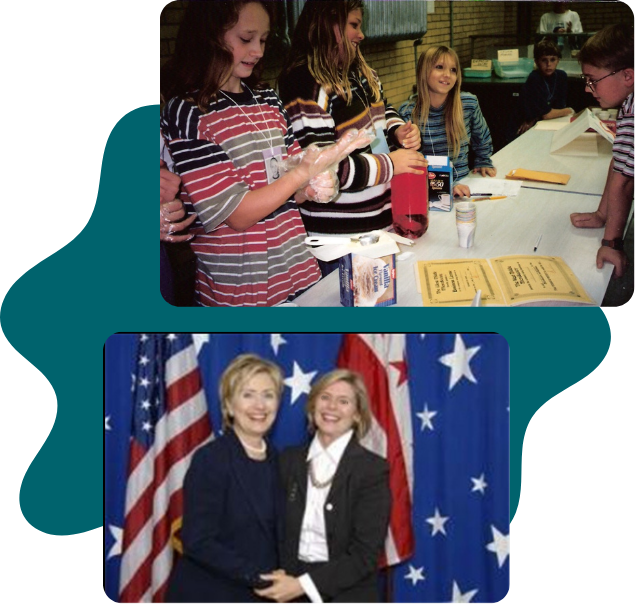
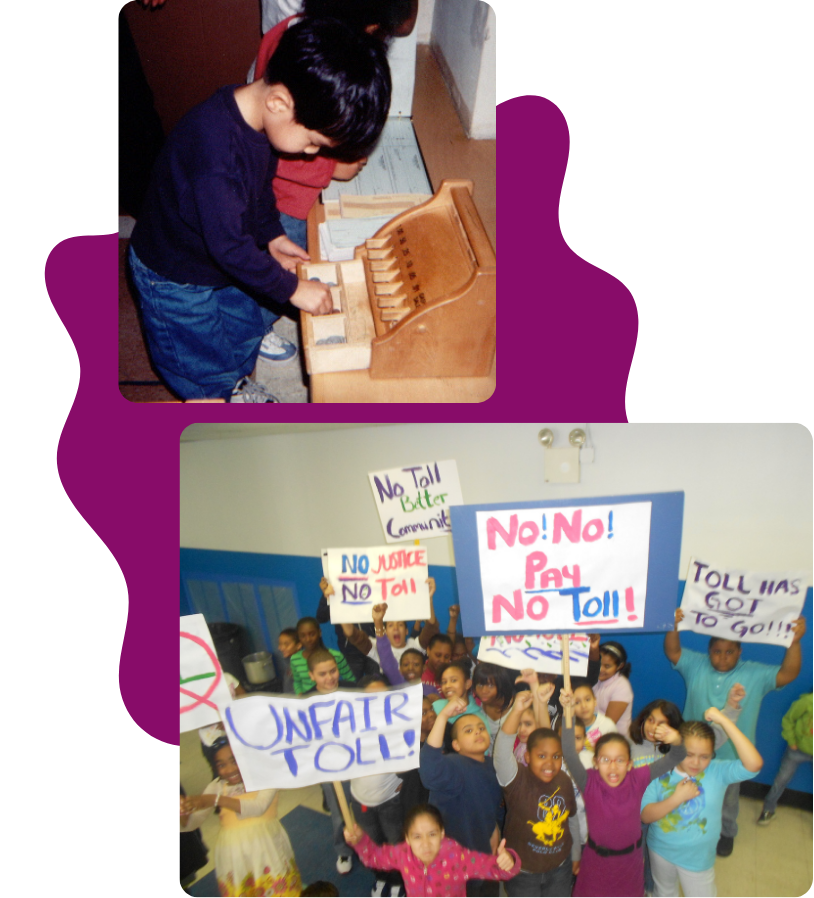
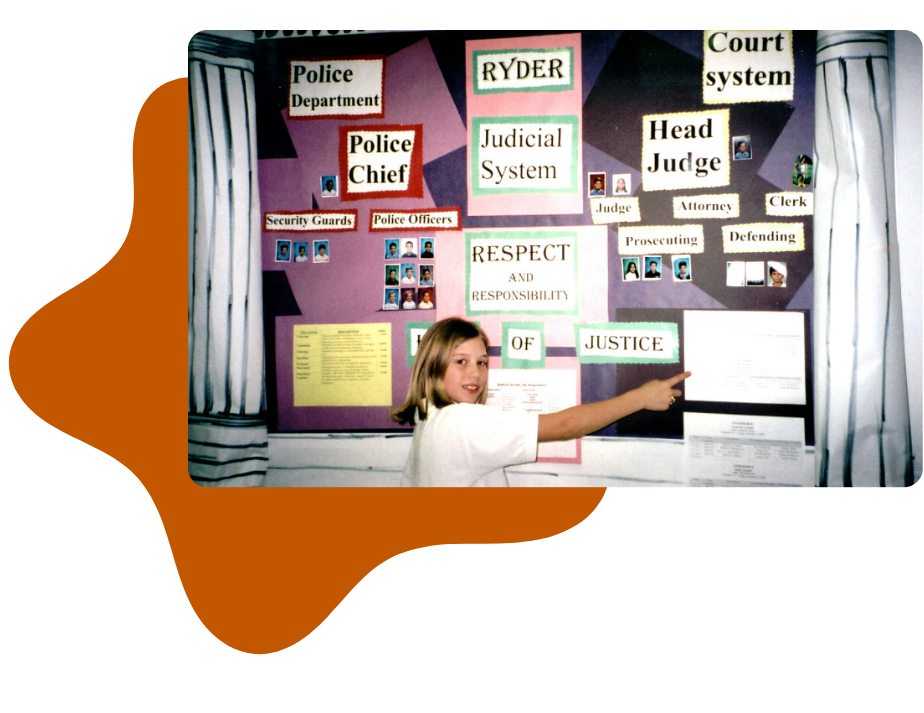
In 1994, West Middle School in Sioux City, Iowa becomes the first middle school to implement MicroSociety, earning praise from Senator Tom Harkin and First Lady Hillary Rodham Clinton for its role in reducing gang activity. In 1996, the first pre-K MicroSociety opens in New York City at Buckle My Shoe.
In 1998, the first MicroSociety charter school opens in Chula Vista, Calif. In 1999, Ryder Corp. launches Florida’s first work-site charter school near Miami, bringing MicroSociety to the children of its employees. Governor Jeb Bush attends the opening day ceremonies. The first after-school program starts at Boys & Girls Harbor in Harlem, led by philanthropist Anthony Drexel Duke.
Working in an increasingly wide range of school environments—serving gifted students, struggling learners, and everyone in between—MicroSociety educators see that the same conditions help all young people flourish: a voice and say in their community, real responsibility, and the feeling they belong.

1998–2001 — Federal Validation and a National Role
In 1998, the U.S. Department of Education launches the Comprehensive School Reform Demonstration initiative to improve outcomes in high-poverty, low-performing schools through research-based, whole-school models.
MicroSociety is approved as a Comprehensive School Reform model by the DOE in 1999, marking a major turning point. This recognition aligns federal policy with George Richmond’s founding vision of MicroSociety as an anti-poverty strategy and helps position MSI as a full-service professional organization that delivers training and support to under-resourced schools.

2002 — A Changing Policy Environment
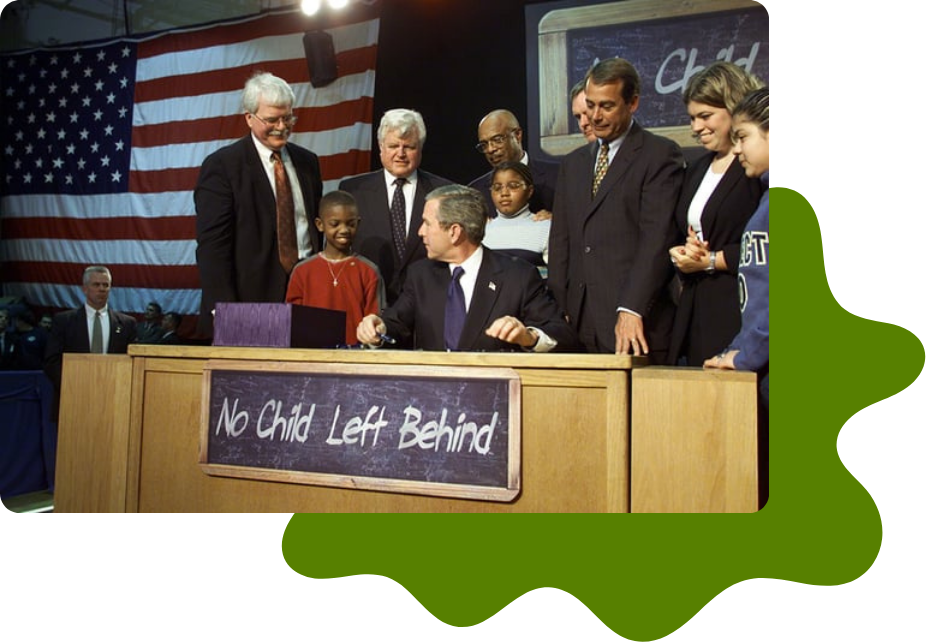
In January 2002, President George W. Bush signs the No Child Left Behind Act into law, significantly expanding federal involvement in K–12 education and ushering in a new era of standards-based accountability.
The law builds on concerns first raised in the landmark 1983 report A Nation at Risk, which called for higher academic standards and stronger school reforms. Over time, policymakers increasingly embrace testing and measurable outcomes as the primary drivers of educational improvement.
For schools, the effects are profound. Standards and accountability systems—initially intended to promote equity and rigor—begin shaping not only expectations for student performance but classroom instruction itself. As schools focus more heavily on tested subjects and federal mandates, the environment grows more challenging for whole-school experiential models like MicroSociety.

2004 — Passing of a Founder
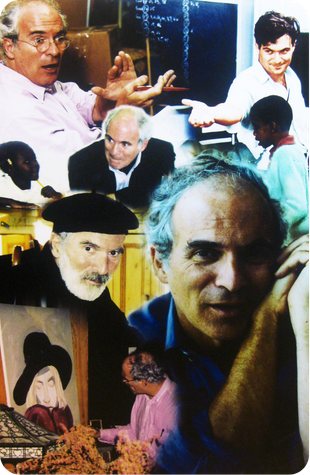
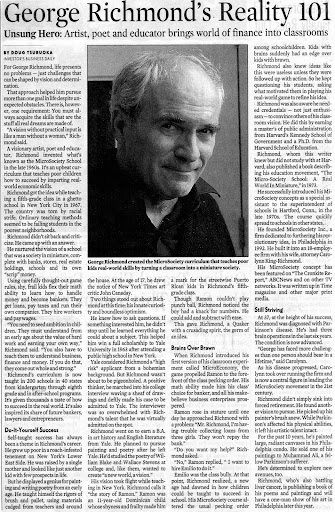
On August 23, 2004, model inventor Dr. George H. Richmond passes away after a two-decade struggle with Parkinson’s disease and a battle with cancer. Former students, educators, and MicroSociety practitioners gather in Philadelphia to celebrate his life, art, and influence on education. His legacy is recognized in Investor’s Business Daily.

2005–2009 — Continuing the Work
Following George’s passing, Carolynn King Richmond continues leading MSI, carrying forward the vision they built together. The years that follow bring continued validation and recognition. In 2005, Dr. Cary Cherniss of Rutgers University publishes School Change and the MicroSociety Program, based on research in ten MicroSociety schools.
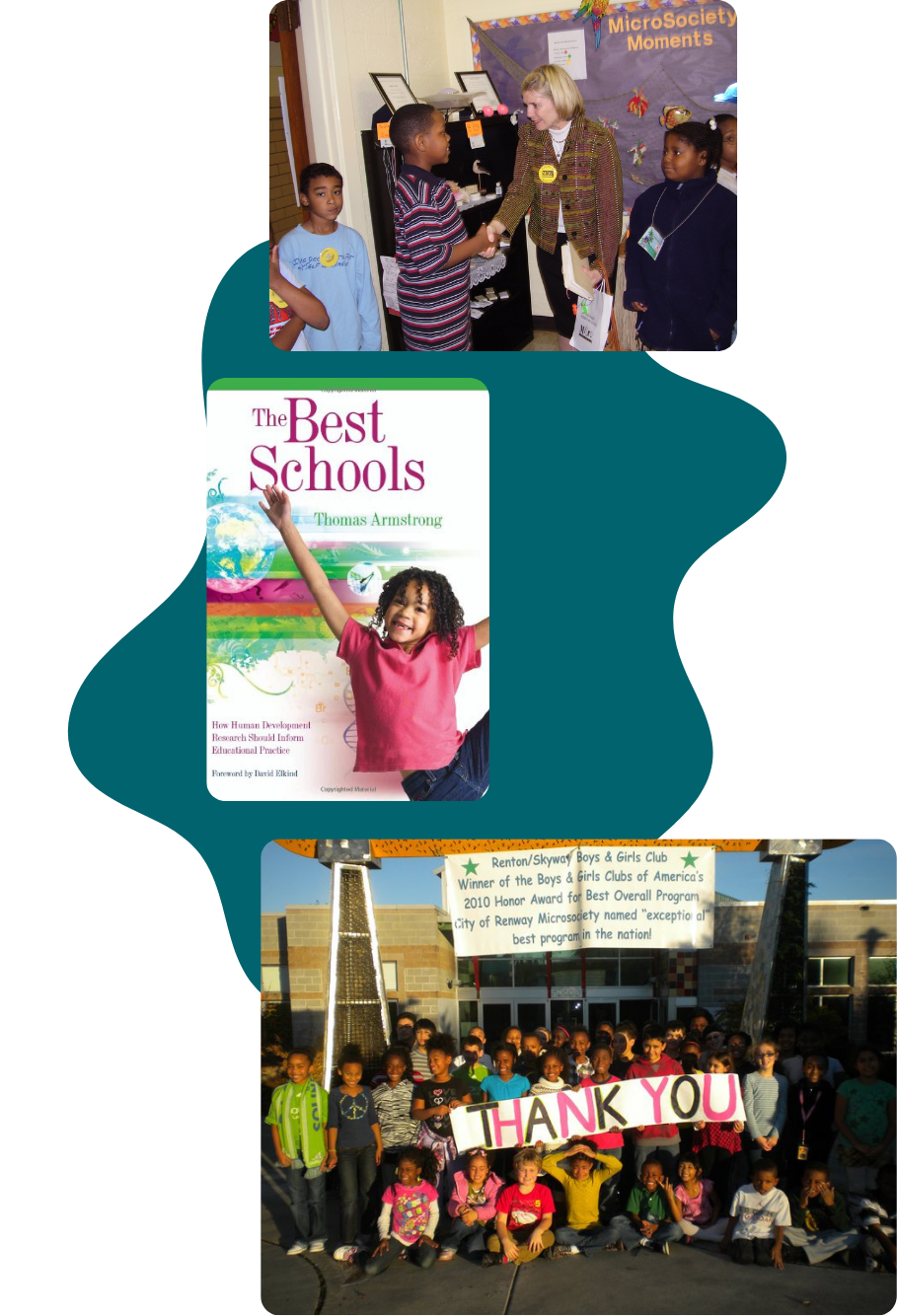
In 2006, two schools participate in a joint project between Oprah Winfrey’s O Ambassadors Program and Free The Children, and author Thomas Armstrong names MicroSociety among the most inventive, successful, and forward-thinking schools profiled in his bestselling book The Best Schools.
Barron’s 40th edition of 1100 Words to Know, published in 2008, calls MicroSociety “an antidote to school boredom.” In 2009, NPR Omaha features Carolynn and the Conestoga MicroSociety School. In 2010, the Renton Skyway Boys & Girls Club receives the national organization’s Best Overall Program Award for its MicroSociety. In 2011, the New York State Department of Education approves MicroSociety as a Title III program supporting refugee and immigrant students.

2010s — Steadfast In a Changing Educational Landscape
As standards and testing become more tightly linked to accountability systems, unintended consequences emerge. Standards increasingly act as ceilings rather than floors, assessment drives instruction, and teaching shifts from professional judgment toward compliance.
Many whole-school reform models disappear during this period, but MicroSociety endures, sustained by schools that understand its impact and protect space for student agency, creativity, purpose, and real-world learning, even as those principles are increasingly crowded out.
In 2019, this enduring influence is recognized by a Greater Philadelphia Innovation Award.

2020–2022 — Crisis, Catalyst, and Creation
When the Covid pandemic shuts down schools, it disrupts learning, strains student wellbeing, and severs many of the personal connections that make education meaningful. For the organization, it also becomes a defining moment—sparking a period of reflection and innovation.
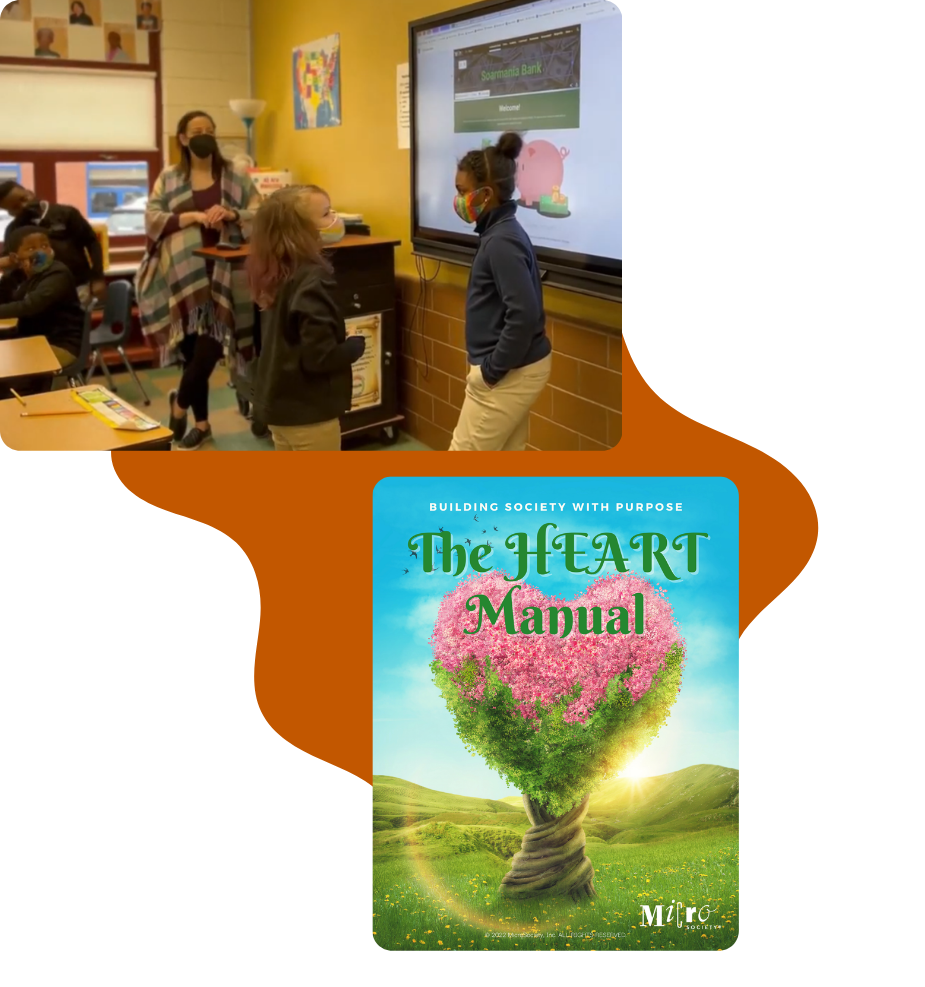
MSI begins developing MicroSociety 2.0, a digital evolution of the model that enables tech-forward society-building while preserving its core principles. At the same time, it creates the HEART curriculum to strengthen the human experience of learning, with a focus on social-emotional development, relationships, reflection, and purpose.
It becomes clear that the core of the model does not need to change—but it does require new tools and support to respond to a changing world.

Today — Evolving for a New Era
The MicroSociety model continues to strengthen its founding purpose: making learning relevant to students’ lives and futures. MSI uses technology intentionally to expand access, support educators, and open new learning opportunities, while preserving the model’s hands-on and human-centered approach.
Digital Tools
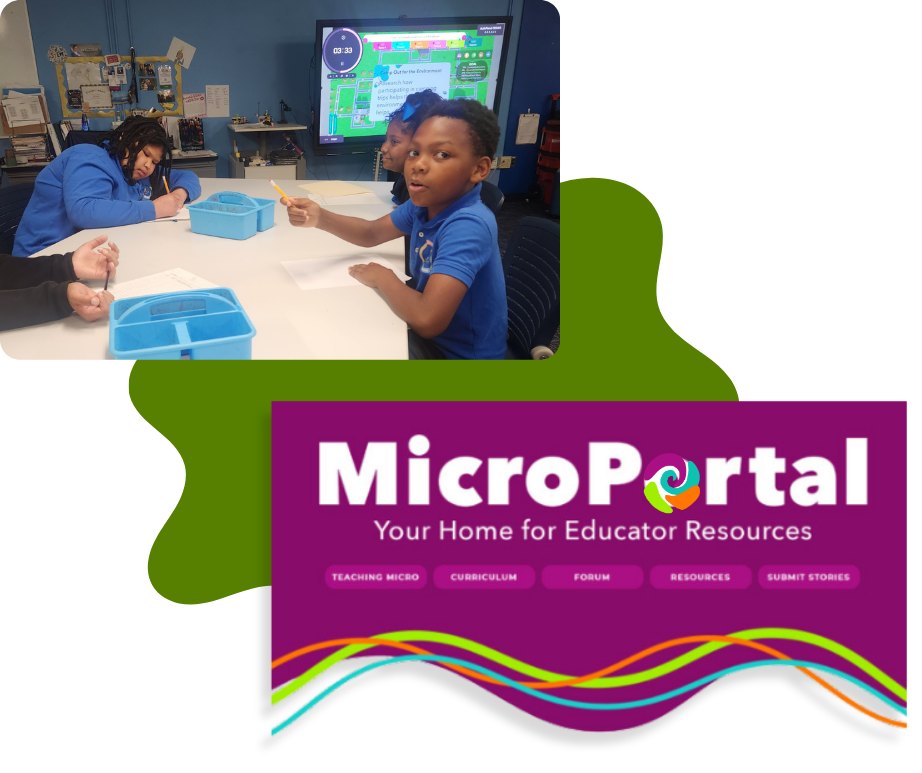
MicroSociety 2.0 brings the model into the digital world students now inhabit and the technology-driven workplaces they will enter. MicroPortal gives educators easy access to curriculum and classroom resources, while MicroForum connects MicroSociety educators around the world. The in-pilot 4th Terra® 3D game allows classroom students to build a society of wellbeing, and MicroExpress, now in development, will simplify implementation by moving key student and teacher training online.
Middle Grades Redesign
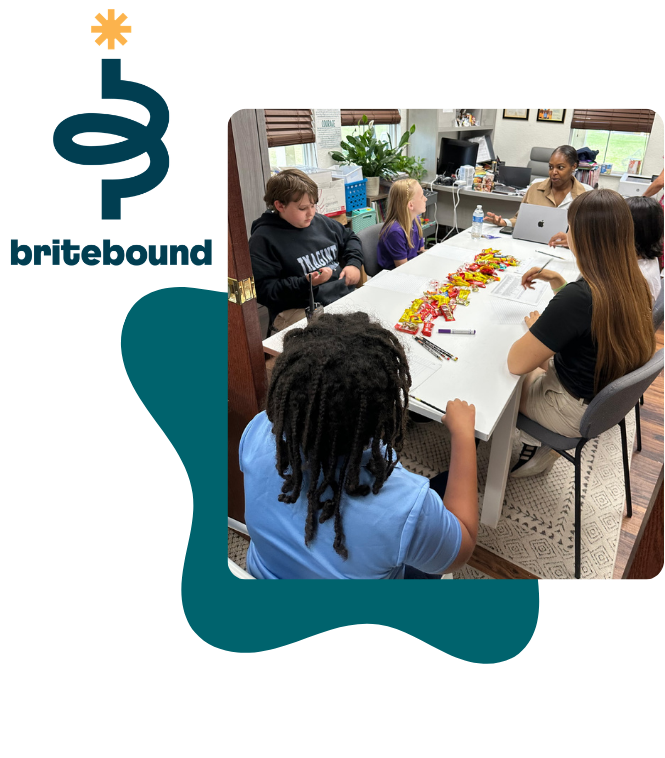
In 2025, with support from a Britebound grant, MSI begins redesigning its middle grades model. Listening to students about what they want, need, and care about—and to community professionals about the evolving world of work—MSI shapes the model to more intentionally center self-discovery and purpose and increase understanding of how economic, political, social, and intellectual systems connect. The redesign also expands exploration of emerging careers in fields like energy, technology, business, and the skilled trades.
In today’s MicroSociety, reading, writing, and mathematics are not ends in themselves—they are tools students use to build better systems, solve problems, and navigate the world around them with creativity and grit.

What Endures
Across every decade, one belief has remained constant: Children thrive when they are trusted with real responsibility and work that’s meaningful to them.
It is a sense of purpose that motivates students to engage—to pay attention, take ownership, and invest in their learning.
This core belief put into practice—tested by time, challenged by change, and strengthened through experience—is why MicroSociety endures.
Hope for the Future
With little real success to show for federal efforts since 2002, our MicroSociety educators tell us that there is a way to course correct, to take the best from the 80’s, 90’s, and 2000’s as we look ahead to the needs of the future.
They remind us that schooling is a human endeavor and that schools must be places where creativity is encouraged, where children are seen as individuals, and where they are given the time, space, and opportunity to be self-reliant, to manage their own environment, and to discover the values that guide their decisions along the way. When their choices fall short, they must be supported in learning how to pivot, adapt, and innovate.
Our educators remind us that we must model curiosity—by listening, observing, and seeking to understand what motivates each student to learn—and help students see it within themselves so they can discover how their unique talents and skills can positively impact the world around them.
This belief in developing the whole child is what gives us hope for every child—and for the future they will shape.